
What the FAA asks for before your CFII checkride
CFII Requirements: Your Questions Answered (2026)
If you already fly as a commercial pilot with an instrument rating, you hold most of what the CFII asks for. Below is each remaining requirement in plain English, from the knowledge tests to the medical on checkride day, so you can see what is left before you book a lesson.


FREQUENTLY ASKED QUESTIONS
CFII Requirements: Your Questions Answered (2026)
What the FAA asks for before your CFII checkride
You need to be at least 18, read, speak, write, and understand English, and hold a commercial or ATP certificate with instrument privileges. On top of that, you log at least 15 hours as pilot in command in the category and class of aircraft for the rating, pass the Flight Instructor Instrument (FII) knowledge test, train with an authorized instructor, get the logbook endorsements, and pass the checkride. If you are not already a flight instructor, add the Fundamentals of Instructing (FOI) knowledge test. Our CFII program shows how we put those steps in order for you.
No. The FAA requires a commercial pilot or airline transport pilot (ATP) certificate first. A commercial certificate needs an instrument rating to go with it, while an ATP certificate already carries instrument privileges. If you are still working on your commercial, our commercial pilot program is the step before this one, and we can map out the whole path with you.
The FAA sets no minimum number of training hours for the CFII rating. You train until your instructor can sign that you are ready for the checkride. Separately, you must have logged at least 15 hours as pilot in command in the category and class of aircraft for the rating (airplanes, for an airplane CFII). Because our course is proficiency-based, your hours depend on how sharp your instrument flying and your explanations already are.
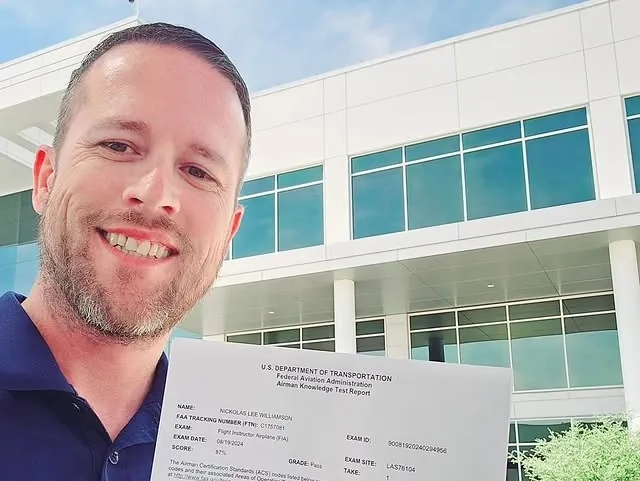
Every CFII applicant passes the Flight Instructor Instrument (FII) knowledge test. The Fundamentals of Instructing (FOI) test is only for applicants who are not yet instructors. You skip the FOI if you already hold a flight or ground instructor certificate, hold a state or local teacher's certificate for 7th grade or higher, or are employed as a teacher at an accredited college or university. If you are already a CFI, you take one test; if not, you take two.
You take it at an FAA testing center, and the FAA lists PSI Services as its testing provider. You pay the provider when you book and bring photo ID with your signature and date of birth. Your passing result must fall within the 24 calendar months before the month of your checkride, so plan your test date with your instructor and it will not lapse while you train. Find the current testing information on the FAA airman testing page.
Not on your first attempt. The FAA does not require proof of training to sit a flight instructor knowledge test the first time, though a retake after a failed test does need it. The ground training still has to be logged before you can earn the certificate, so it makes sense to work through the instrument instructing topics with your instructor before you sit the test.
You train with an authorized instructor on the ten areas of operation for the instrument instructor rating, then get a logbook endorsement that you are ready for the checkride. That endorsement sits next to the standard ones every practical test needs, so expect three endorsements for the test itself. The CFII has no spin endorsement, because that applies to airplane and glider instructor ratings. Our CFII checkride day guide lists each endorsement and the paperwork the examiner checks.
No. The FAA allows the CFII to be your first flight instructor certificate. If you go that route, you add the FOI knowledge test (unless you qualify for the waiver), training on the fundamentals of instructing, and a checkride that covers teaching from the ground up. The FAA also sets extra experience requirements for the instructor who trains a first-time instructor applicant. We usually recommend earning your CFI first so the CFII becomes a simpler add-on, and we will talk through which order fits your goals.
For the checkride in the airplane, you need at least a third-class medical certificate. The rule has an exception for pilots flying under BasicMed within its limits. On training flights where you act as pilot in command, the usual medical rules for any pilot apply. Once you hold the CFII, you need no medical to instruct as long as you are not acting as pilot in command or as a required crewmember. If your medical has lapsed, book your Aviation Medical Examiner (AME) visit early so it never holds up your checkride date.
The PTS is the Flight Instructor Instrument Practical Test Standards, FAA-S-8081-9E, effective May 31, 2024. In 2026 the airplane CFII checkride is still graded against this PTS, while the initial CFI and instrument rating tests now use the Airman Certification Standards (ACS). It has ten areas of operation, from Fundamentals of Instructing to Postflight Procedures, and the examiner plays your student while you fly and explain at the same time. The FAA can update its standards, so check the FAA testing standards page before your test. Our CFII PTS guide walks through each area.
No. At a Part 61 school like ours, the CFII checkride is flown in an airplane. A basic aviation training device (BATD) cannot be used on a practical test. Our FAA-approved Gleim BATD is where you practice teaching, pausing a scenario mid-approach and explaining what your student should do next, before you take that skill into the cockpit.
Every lesson starts at our hangar at Hicks Airfield (T67), 110 Aviator Drive in north Fort Worth. You train one on one with an experienced instructor in our IFR-equipped Cessna 172s and our Gleim BATD. Each lesson opens with a briefing and closes with a debrief, and you practice approaches under the hood from the right seat, the seat you will teach from. Hicks is a non-towered field, so you fly the pattern without waiting on tower clearances for every move.
Our CFII course is estimated at around $2,000, and it typically takes 2 to 4 weeks full-time or 1 to 2 months part-time. Your pace and your starting proficiency drive both numbers, and FAA test and examiner fees go to other parties. See the breakdown in our CFII cost guide and the plan in our CFII timeline.
Still have questions?
If you have any other questions, please get in contact!
Stop dreaming. Start flying.
Ready to Check Off Your CFII Requirements?
Bring this list to a quick conversation with our team. Tell us which certificates and tests you already have, and we will lay out the steps left between you and your CFII checkride at Hicks Airfield. Call us at 1-817-398-3941 or send us a message.